AI is not killing studio rentals, it is redefining them. In 2026 brands rent studios shorter but more often, with a brief built for a hybrid AI workflow. Here is how the model works step by step and why hourly rental still beats running your own studio.
AI is not killing studio rentals, it is changing the rhythm
The 2026 numbers are merciless. A traditional product session costs 350 to 1 000 PLN per SKU; an AI-generated image costs 12 to 50 PLN. ASOS reports a 340 percent conversion lift on product cards after rolling out AI models. Amazon opened Amazon AI Studio for third-party sellers in Q3 2025. Fast fashion now produces more than 10 000 AI images per day. The first reflex for many e-commerce brands is: if we have AI, why rent a studio at all? That is a costly mistake. A brand that abandons the studio entirely and runs 100 percent AI loses credibility in many categories (54 percent of shoppers worry that AI misrepresents the product; the number climbs in the 45 plus group). The second mistake is building your own studio: a cyclorama setup with Godox and Nanlite lighting plus 100 m² of space costs 80 000 to 200 000 PLN, plus the monthly cost of premises. For a brand that will shoot once a quarter anyway, the maths does not work. The third and now most common answer is renting a studio on a new rhythm: short reference sessions (2 to 4 hours), more often (quarterly or monthly), with a specific brief built for the hybrid AI workflow.
What still belongs in the studio
In 2026, AI still loses badly in a few specific areas where a real studio session remains the only credible source of material.
- Product texture, leather, linen, knitwear, jewellery, glass. AI generates something similar that the customer then rejects as inaccurate. Real photo is a defence against return rates.
- Your specific product, AI needs references, and the best results (Firefly with reference images) require an existing studio shot. Your product, not AI's idea of the product.
- Real people with authentic talent, UGC, live shopping, podcasts. An AI model has no voice and no story.
- Sets with real props, food, cosmetics in use, fashion in motion.
- The first session for a brand, you need to train the AI library on your brand book. That requires real photos as the starting material.
What AI does better today
AI in a hybrid workflow does not replace the studio. It scales what the studio already produced. In these five areas AI is now faster, cheaper and better.
- Background variants, colours, seasons, locations. One studio session, 50 lifestyle contexts generated in Firefly.
- Product colour variants, one t-shirt, 12 colours, one session.
- Scaling across formats, 1:1, 4:5, 9:16, banners, ad-specific creatives.
- Seasonal refreshes, Christmas sets, spring backgrounds, birthday campaigns.
- Creative A/B tests, 10 variants of the same Meta ad without returning to set.
Why rent a studio instead of building your own
A frequent client question: if we shoot regularly, should we just build our own corner? The 2026 maths usually says no. Three real scenarios.
Scenario 1: a small in-office setup
You buy a 3 x 3 m cyclorama, two flash heads, modifiers, stands, backdrops. Investment around 25 000 to 40 000 PLN, plus the office space that stops being office space. Works for simple packshots, but not for the hybrid AI workflow: too little distance to backdrop, no full cyclorama, weaker lighting.
Scenario 2: your own full 100 m² studio
80 000 to 200 000 PLN in equipment, plus city-centre rent (7 000 to 15 000 PLN per month), plus operating costs. Starts to make sense at 80 plus hours of in-house production per month. Most e-commerce brands shoot 8 to 20.
Scenario 3: rent a studio by the hour
You pay only for hours you actually use. All gear (Godox, Nanlite, modifiers, backdrops) is included. Full-size cyclorama. Make-up Room for the talent. Zero upkeep cost in months when you do not shoot. For 90 percent of e-commerce brands, hourly rental is simply cheaper per final image.
The hybrid workflow, step by step
The hybrid workflow has six steps. Each is designed to squeeze maximum value from both the studio and the AI tooling.
Step 1: a brief that thinks about AI from the start
In the session brief you label which shots are AI base material (clean lighting, neutral background, static model) and which are final assets (lifestyle, motion, real set). This is a different session from a traditional one.
Step 2: book the studio for 2 to 4 hours, not a full day
This is where the rental model changes. You rent shorter, but more precisely. Instead of a full-day booking and 200 frames of the same product across 8 settings, you book 2 to 4 hours in a studio with a cyclorama and produce 20 clean reference frames on neutral backgrounds, in consistent lighting, at high resolution. That is why hourly studio rental (pay per hour) is more attractive in 2026 than day rates: the AI workflow does not need a full day, it needs repeatability and technical quality. Critical technical requirements: minimum 6 000 by 6 000 px resolution, visible contact shadow, product in 3 to 5 angles, brand book colour reference in frame.
Step 3: cleanup and AI prep
After the session, a retoucher (or an AI tool) cuts the product, normalises lighting and builds the base library (clean cuts, transparent background). This is your raw material for every variant.
Step 4: generate variants in AI
This is where Firefly Generative Fill 2026 (with reference images), Photoroom, Krea, Photoshop enter. For each product you generate 10 lifestyle scenes, 5 seasonal sets, 12 colour variants (if the product ships in variants) and 6 ad formats per channel.
Step 5: human quality control
The most important step, and the one most brands skip. A human (art director or photographer) must review every image and reject the ones where AI distorted the logo, the texture, the proportions. That is 5 to 15 percent of the output. Skipping this step equals customer complaints.
Step 6: feedback loop back to studio
After three months of work on the library, you start seeing which shots AI fails to generate variants from. Those categories go back into a session. The studio becomes a reorder line, not a one-time cost.
Tools that actually work in 2026
The tooling stack for a hybrid workflow in 2026 is stable. These five tools cover 95 percent of real e-commerce needs.
- Adobe Firefly + Photoshop Generative Fill with reference images, industry standard, good shadows, composition control
- Photoroom, excellent for fast catalogue shots and automation
- Krea AI, strong for lifestyle scenes and mood photography
- Claid.ai, tuned for Shopify and Amazon
- Amazon AI Studio, if you sell on Amazon, single-pane integration
What renting SPOT Studio for a hybrid AI workflow looks like
At SPOT Studio we understand that in 2026 a session is no longer the end goal. It is raw material for downstream AI work. Our rental model is built for that: short sessions, all gear included, online booking from one hour.
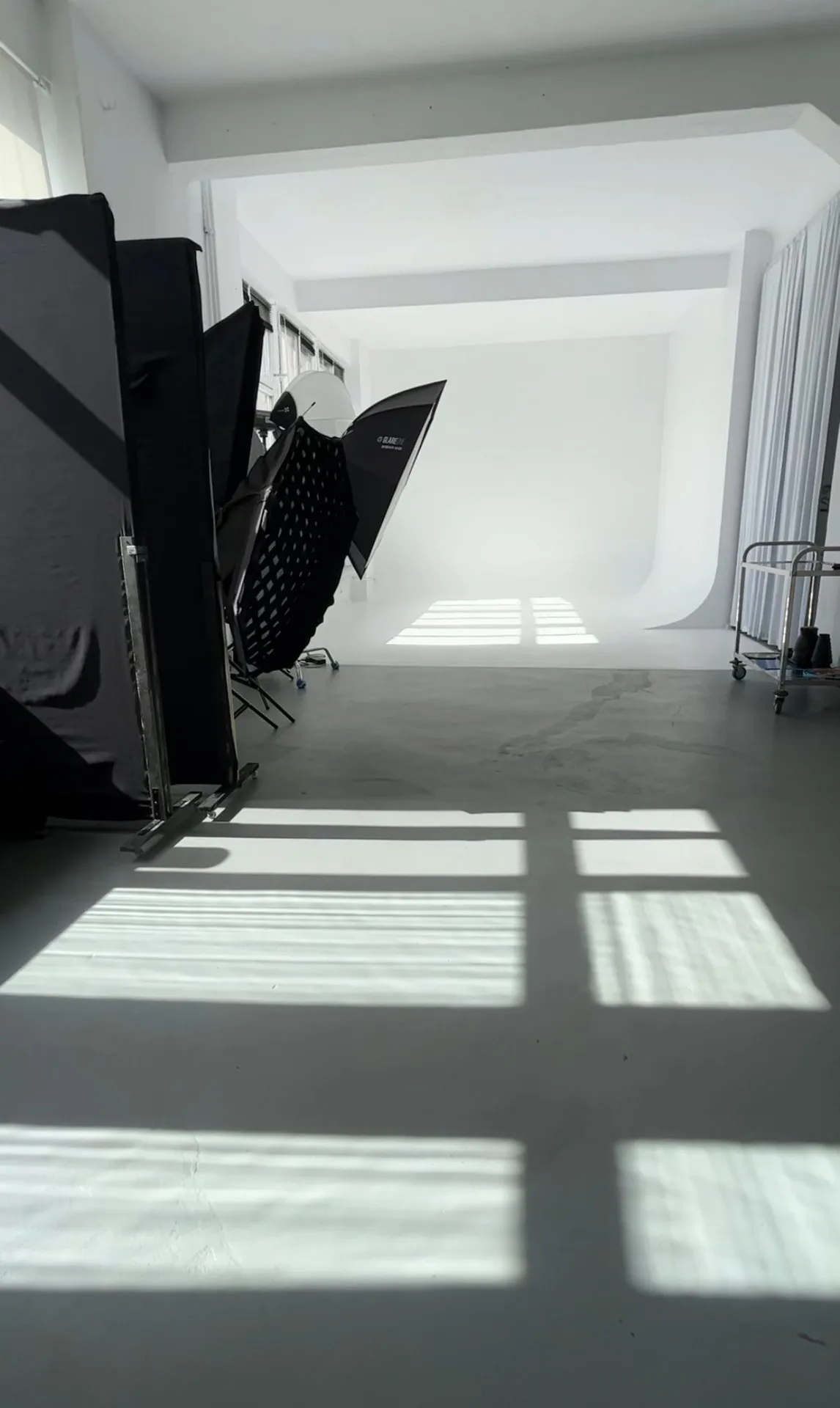
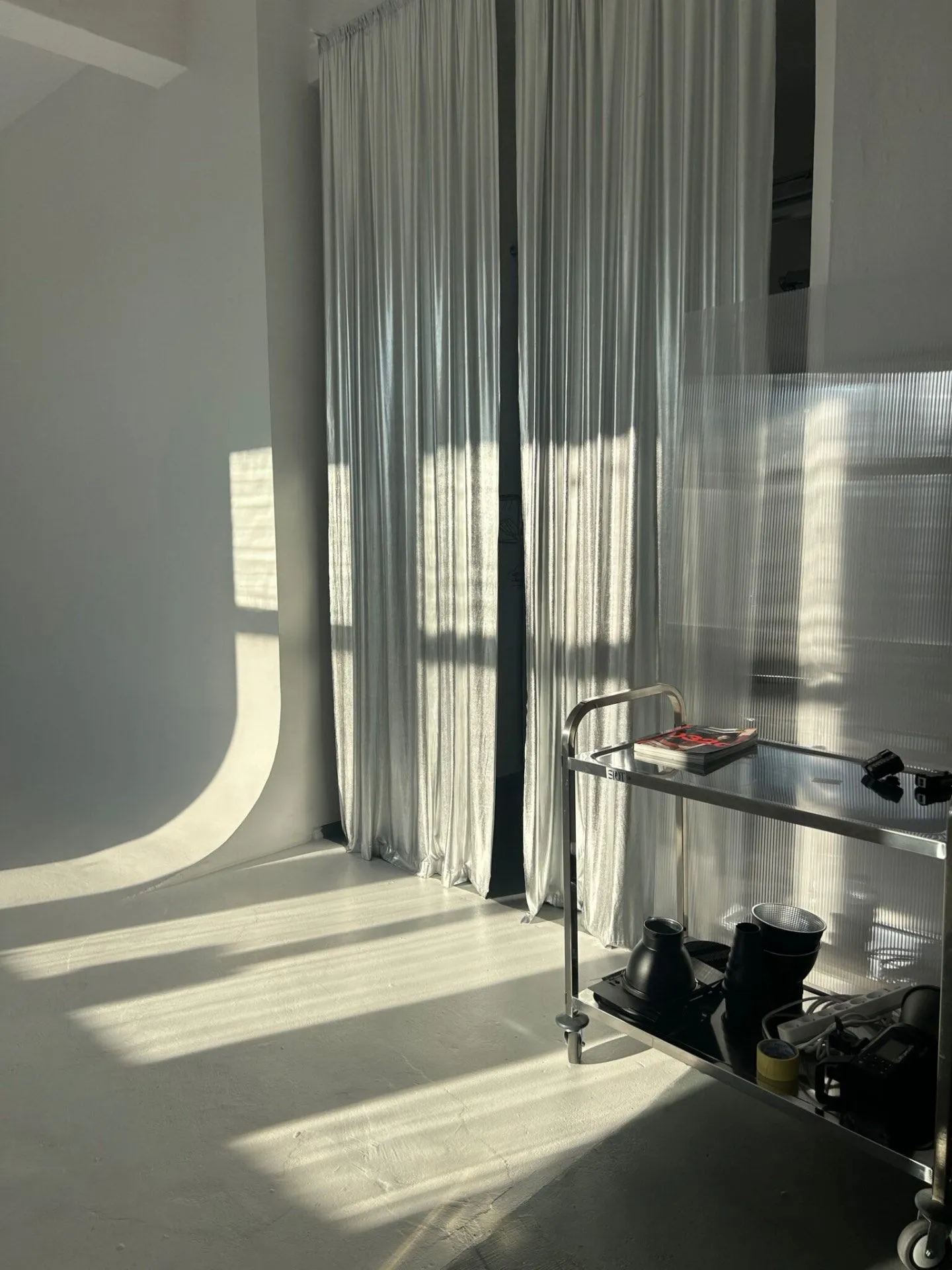
- 150 m² studio with cyclorama at Lelewela 4, clean technical conditions for the AI base layer, plus full Godox and Nanlite lighting and a complete modifier set
- SPOT 2.0 60 m² at Solskiego, our second location for smaller and fast reference sessions (1 to 2 hours, 10 to 20 shots)
- Make-up Room plus space to prep the product and talent
- All gear included in the rental, no per-light or per-modifier surcharge
- Online booking from one hour, calendar updated in real time
Three rental models that fit the hybrid workflow
Three rental models cover the majority of e-commerce scenarios in 2026.
Quarterly reference session
For brands with 5 to 20 SKUs that refresh content regularly. Typical booking: 2 to 4 hours per quarter. Covers a campaign calendar and keeps production cost below the traditional model.
Subscription rental
For brands with continuous production and 50 plus SKUs. Typical booking: 4 to 8 hours per month. Stable relationship, predictable cost, more frequent AI library refresh.
Pre-campaign sprint
Brand launch, seasonal campaign, Black Friday. Typical booking: 6 to 10 hours, one-off. Full reference material for an entire campaign in a single day.
A brand that abandons the studio entirely and runs 100 percent AI loses credibility, and loses control over what its own product actually looks like.
Book a reference session for your hybrid AI workflow
2 to 4 hours in a cyclorama studio, full gear included, online booking from one hour. Check availability